Chios Mastic: The History, Production and Uses of a Unique Product

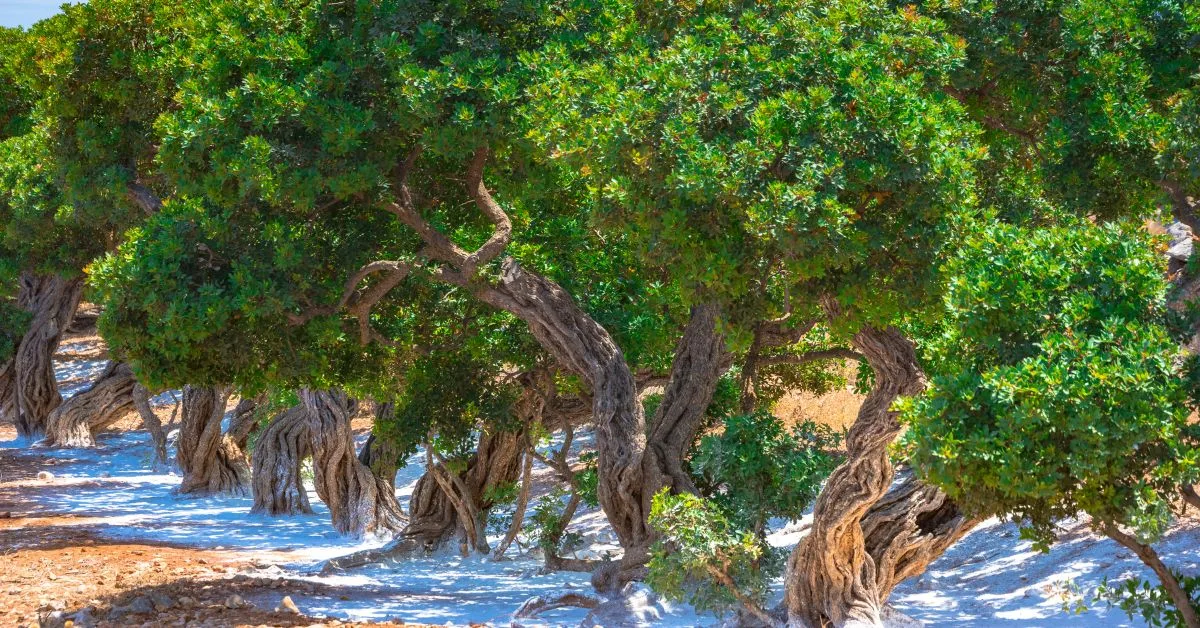

Some local products are so closely connected to a place that they become part of its very identity. On Chios, that product is undoubtedly mastic. Chios Mastic is the natural, aromatic resin produced by the mastic tree, Pistacia lentiscus var. Chia. It appears in small drops on the trunk and branches after growers make shallow incisions in the tree. Once it solidifies, it forms the characteristic “tears” of mastic. Behind these small, translucent pieces lies an entire tradition. Cultivation requires time, manual work, and knowledge passed down from generation to generation. Since 2014, the know-how of cultivating mastic on Chios has been included in UNESCO’s Representative List of the Intangible Cultural Heritage of Humanity. Mastic, therefore, is much more than a famous Greek product. It offers a different way to discover southern Chios, its villages, and a tradition that remains alive to this day.
Chios Mastic is the resinous secretion of the mastic tree. After small incisions are made in the trunk and larger branches, the resin slowly begins to flow and form droplets. At first, it is relatively sticky. It then gradually solidifies and takes on its characteristic crystalline form. Its distinctive flavor and aroma have made it an ingredient with a wide variety of uses. However, what makes Chios Mastic even more remarkable is its close geographical connection to the island. Its systematic production is closely associated with southern Chios and the famous Mastihohoria, or Mastic Villages.
The relationship between Chios and mastic goes back centuries. The aromatic resin was known in ancient times and, over the years, became associated with different uses and trade routes. Its value profoundly influenced the history of southern Chios. Production became organized around specific settlements, while mastic developed into an important part of the local economy. Even more importantly, its cultivation became much more than an agricultural activity. It shaped customs, cooperation, and social ties within local communities. Knowledge of cultivation and harvesting has traditionally been passed from older generations to younger ones, while the production process has long been associated with family life and mutual support within the community.
To truly discover Chios Mastic, you need to head to the southern part of the island. This is where the famous Mastihohoria are located, historic villages that developed around mastic production. Their connection with mastic cultivation remains visible today. Cultivated areas filled with mastic trees stretch beyond the settlements, while production continues to be part of everyday life for many local residents. At the same time, the villages themselves are an important part of the travel experience on Chios. Their distinctive architecture, narrow streets, and traditional character reveal a different side of the island. Villages such as Mesta, Pyrgi, and Olympi are characteristic stops on a journey through southern Chios. Here, the local product is directly connected to the place where it is produced.
Mastic production is a process that extends far beyond a few days of harvesting. Caring for the trees takes place throughout much of the year and involves several different stages. During winter, growers carry out tasks such as pruning and caring for the mastic trees. As summer approaches, preparation of the ground around each tree begins. This stage is essential because the mastic will eventually fall to the ground. Therefore, the area beneath each tree is carefully cleaned and prepared. This is followed by the most characteristic stage of the production process: “kentima,” or making incisions in the mastic tree.
During the summer, growers make small, shallow incisions in the trunk and main branches using a special tool. Natural resin gradually begins to flow through these cuts. The mastic forms small droplets and then solidifies, creating the well-known mastic “tears.” The process requires experience and precision. It is not simply a mechanical task. Knowing how and where to make the incisions is part of the traditional expertise that has been passed down through generations. This is one of the reasons why UNESCO recognized not simply the product itself, but the know-how of cultivating mastic as an element of intangible cultural heritage.
Once the resin has sufficiently solidified, harvesting begins. The larger pieces are collected first, followed by the smaller ones. However, the process does not end there. Raw mastic requires careful cleaning and sorting. Traditionally, much of this work is carried out by hand. The mastic is sieved, sorted, and washed before moving on to the next stages of processing and quality control. Cleaning is particularly demanding. At the same time, it reveals just how much human effort lies behind even a small package of mastic.
In 2014, UNESCO inscribed the know-how of cultivating mastic on Chios on the Representative List of the Intangible Cultural Heritage of Humanity. This recognition concerns much more than agricultural production. It encompasses the knowledge, techniques, and social practices that have developed around mastic. Mastic cultivation has traditionally been a family activity. Older generations pass their techniques on to younger family members, helping to keep this knowledge alive. Therefore, when we talk about Chios Mastic, we are talking simultaneously about a product, an agricultural technique, and an important part of the island’s collective heritage.
The geographical identity of mastic is also protected at European level. Chios Mastic has been registered as a Protected Designation of Origin (PDO) product, further strengthening its connection with its place of production. Protecting the name is particularly important. It helps consumers identify the authentic product while also protecting a form of production directly linked to Chios. Origin, therefore, is not simply a detail printed on the packaging. It is an essential part of the product’s identity.
Gastronomy is perhaps one of the most immediate ways for visitors to discover mastic. Its characteristic aroma can be incorporated into both traditional and contemporary recipes. In confectionery, it is used in sweets, ice cream, creams, and baked goods. At the same time, it can add its distinctive aroma to beverages and various culinary creations. Mastic liqueur is also particularly well known. On Chios, it represents another way in which this local product has evolved from traditional production into a modern gastronomic experience. Mastic is also used in jams, chocolates, dairy products, sauces, and other creations. Its intense aromatic character means that only a small quantity is usually needed. This distinctive quality allows chefs and food producers to use it in many different ways.
The uses of mastic are not limited to gastronomy. Today, it is used as an ingredient in several different categories of products. It can be found in toothpaste, oral care products, creams, cosmetics, and fragrances. It is also available in different forms, including natural mastic tears, powder, oil, and chewing gum. This variety of applications demonstrates how a traditional agricultural product can develop a modern commercial presence without losing its connection to its place of origin. For visitors to Chios, therefore, mastic is not found only on shelves displaying local foods. It appears in many different products they may encounter during their trip.
Discovering mastic can become the starting point for an entire journey across the island. Visiting the Mastihohoria allows travelers to see firsthand the environment in which this remarkable tradition developed. At the same time, exploring southern Chios can be combined with stops in villages, local shops, and places that showcase the history and culture surrounding mastic. In this way, a local product becomes a travel experience. Visitors do not simply discover its taste. They also learn about the place, the people, and the practices behind it. This connection between production and destination is one of the most fascinating aspects of Chios’ gastronomic identity.
The value of mastic lies in the combination of many different elements. There is the natural raw material, but also the expertise of the growers. There is its long history, as well as the many ways it is used today. Above all, however, there is its direct connection with a specific place. In southern Chios, mastic has influenced the economy, everyday life, and social organization of local communities. The know-how behind its cultivation continues to be passed down, while the product itself continues to find new applications. For this reason, Chios Mastic is not simply another local Greek product. It is a living part of the island’s cultural heritage.
A trip to Chios takes on a different dimension when combined with discovering its local products. Mastic is the ideal starting point for exploring the southern part of the island and its historic Mastihohoria. On Filoxeno.com, you can discover accommodation options and organize your stay on Chios. Combine your trip with visits to traditional villages, local flavors, and experiences that reveal the island’s distinctive identity. After all, mastic is not simply something you taste on Chios. It is one of the best ways to discover the island’s history and culture.